

Institutional real estate investment—capital deployed by large entities like pension funds, sovereign wealth funds, insurance companies, private equity firms, and REITs—is rapidly reshaping global property markets. This trend is not just about rising numbers; it signals structural maturation in commercial and residential real estate, creating opportunities and shifting risk dynamics for all types of investors.
📈 What Is Institutional Real Estate Investment Growth?
Institutional real estate investment growth refers to the increasing flow of large-scale capital into property assets. Unlike individual homebuyers or small-scale investors, institutional players commit billions of dollars into diversified real estate portfolios, spanning commercial offices, retail malls, logistics parks, residential developments, and alternative assets like data centers or life sciences facilities.
This growth matters because institutional capital:
- Provides liquidity and depth to markets that were traditionally illiquid.
- Enhances transparency and professionalism, setting benchmarks in valuation, leasing, and asset management.
- Signals confidence in long-term real estate fundamentals, attracting both domestic and foreign investment.
📊 Recent Growth Stories & Data
1. Institutional Investments in Indian Real Estate Hit Record Levels
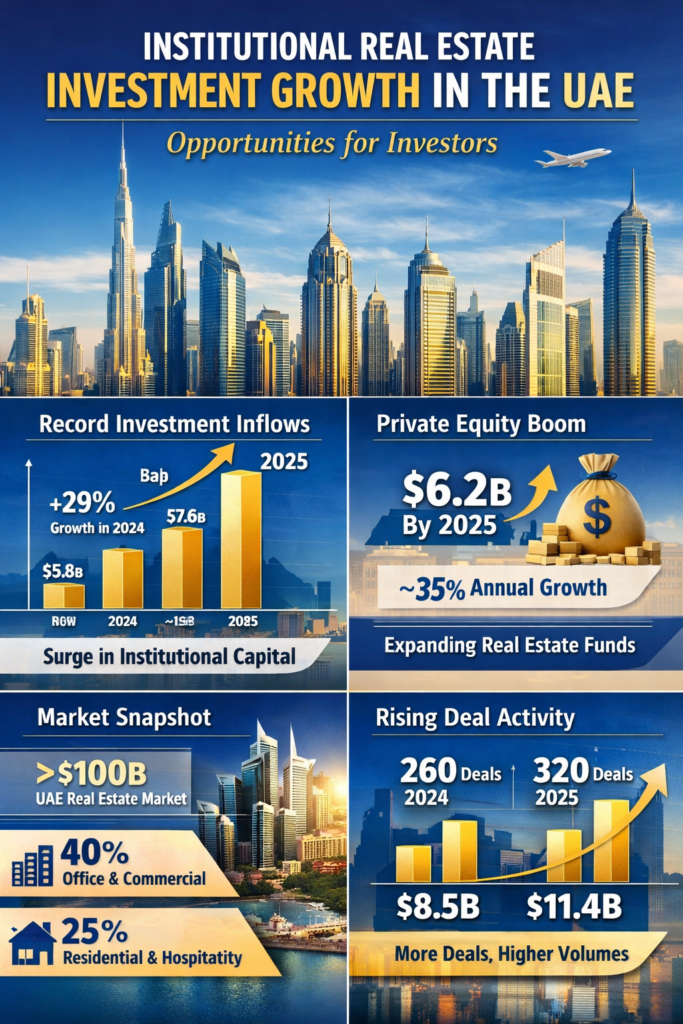
In 2025, India’s real estate market experienced a historic surge in institutional investment, with inflows reaching around $8.5 billion, marking a 29% year-on-year rise versus 2024. The last quarter alone saw over $4.2 billion in transactions – the highest ever in a single quarter, highlighting strong deal momentum. Domestic institutional capital more than doubled, accounting for 57% of total inflows, underscoring rising confidence among Indian investors. Office assets continued to dominate, capturing the largest share of investment activity.
Some reports even estimate institutional inflows surpassing $10 billion in 2025 when broader platforms and commitments are included, signaling deeper capital participation and future deployment pipelines.
2. City-Level Growth Highlights
Regional investment patterns also reflect evolving investor interest. For example:
- Kolkata recorded a dramatic ~400% surge in institutional investments, primarily driven by large retail transactions and increased interest from global managers.
- Traditional hubs like Mumbai and Bengaluru continue to attract robust flows, reinforcing their status as India’s premier investment destinations.
3. REITs Gaining Traction
Real Estate Investment Trusts (REITs) remain a major channel for institutional deployment and investor access. Recent trends show REITs delivering strong double-digit returns in India, even outperforming broader equity markets, partly due to favorable interest rate conditions and heightened demand for quality office assets.
Policy changes—like reduced holding periods and lower capital gains taxes—are further enhancing institutional and retail demand for REITs, making them attractive vehicles for stable income and diversification.
📌 Why This Growth Matters for Investors
1. Greater Market Stability and Liquidity
Institutional capital brings a high degree of professional oversight and long investment horizons, which tends to reduce volatility in real estate markets. Large transactions and stable tenant leases contribute to more predictable cash flows and higher asset quality.
2. Enhanced Access Through REITs & InvITs
REITs and Infrastructure Investment Trusts (InvITs) allow retail and smaller investors to tap into institutional-grade real estate returns without requiring enormous upfront capital. With regulatory frameworks evolving (including tax changes favoring REIT investment), this is opening real estate to a broader base of participants.
3. Diversification Benefits
Institutional growth often spans multiple asset classes—office, residential, retail, industrial/logistics, and alternative sectors like data centers or life sciences. This diversification helps investors reduce portfolio risk while offering exposure to emerging property segments with strong demand fundamentals.
4. Rising Domestic Confidence
The notable increase in domestic institutional participation in markets like India suggests that local investors are increasingly confident about long-term growth prospects. That reduces reliance on foreign capital and points to deepening capital markets infrastructure.
📍 Key Takeaways for Investors
| Trend | What It Signals |
|---|---|
| Record institutional inflows | Strengthening fundamentals and investor confidence |
| Domestic capital leading growth | Local market maturation and better transparency |
| REITs delivering strong returns | Broader access to real estate income streams |
| Growth in tier-2 and regional markets | Diversification beyond traditional metros |
Final Thoughts
Institutional real estate investment growth is reshaping how property markets function globally and in emerging economies like India. For investors, this trend means more professionalized markets, better liquidity, diversified opportunities, and new avenues to participate through REITs and similar vehicles.
Whether you’re a seasoned institutional allocator or a retail investor seeking long-term diversification, understanding these shifts equips you to make smarter decisions in a dynamic real estate landscape.